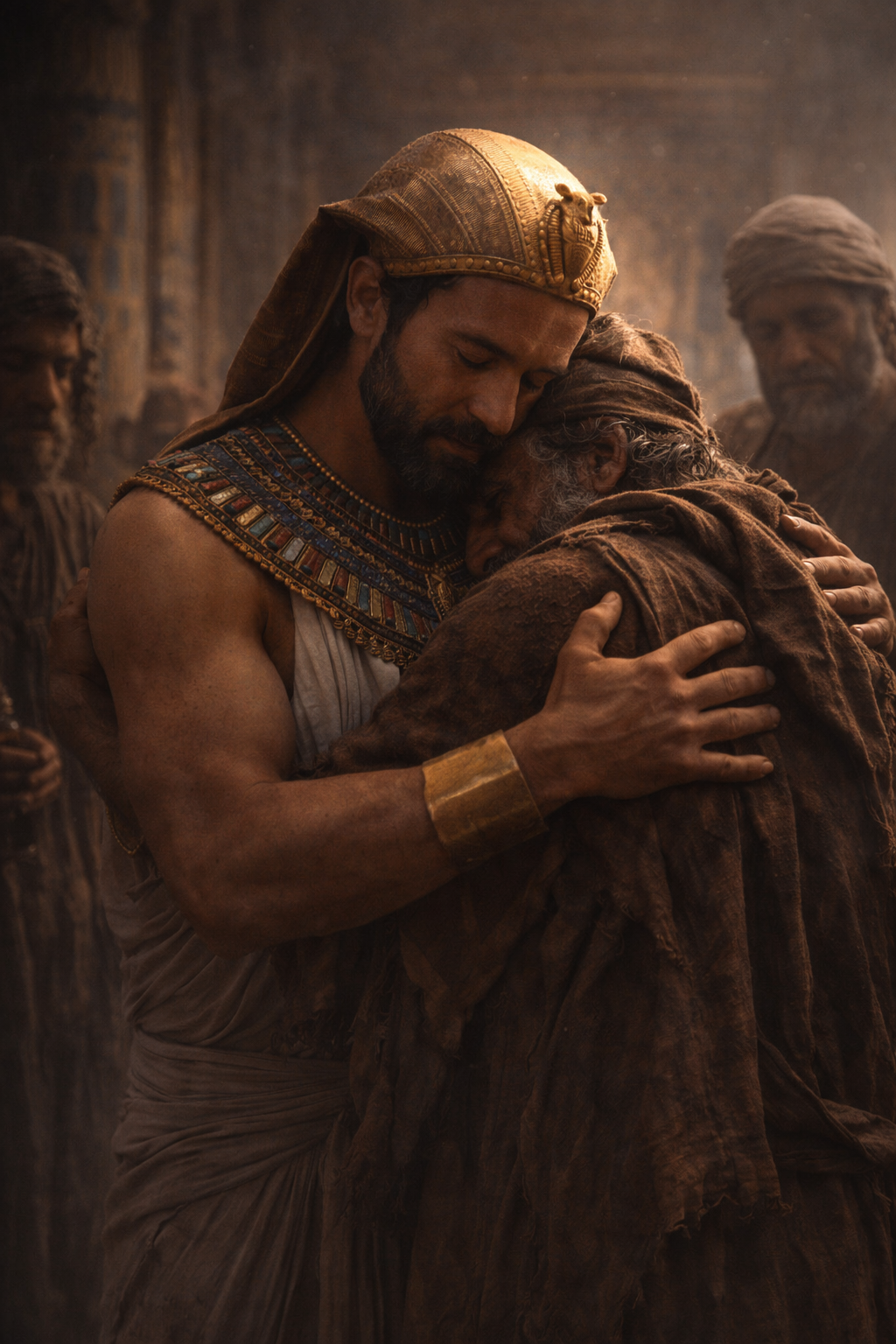
The story of Joseph in Genesis 37–50 is one of the most dramatic and meaningful stories in the Bible. It begins with betrayal between brothers and ends with forgiveness and restoration. Joseph’s journey from slavery to leadership reveals how God can work through even the most painful circumstances.
Story of Joseph Explained
God had chosen Abraham. Then Isaac. Then Jacob.
From Jacob came twelve sons—the beginning of what would become the twelve tribes of Israel.
But Jacob had a favorite.
Joseph.
He was the eleventh son, born to Rachel—the wife Jacob actually loved. And Jacob didn’t hide his favoritism. He gave Joseph a special robe, richly ornamented, the kind that said, “This one’s different. This one matters more.”
Joseph’s brothers noticed. How could they not?
Then Joseph started having dreams. Dreams where his brothers’ sheaves of grain bowed down to his. Dreams where the sun, moon, and eleven stars bowed to him. And Joseph—seventeen years old and apparently oblivious—told his brothers about these dreams.
“So you think you’re going to rule over us?” they sneered.
They already resented him. Now they hated him.
One day, Jacob sent Joseph out to check on his brothers while they were tending flocks far from home. When they saw him coming in the distance—that colorful robe visible from far away—someone muttered, “Here comes that dreamer.”
“Let’s kill him,” one of them said.
“We’ll throw him in a pit and say a wild animal got him. Then we’ll see what comes of his dreams.”
But Reuben, the oldest, talked them down.
“Don’t shed blood. Just throw him in the cistern.” He was secretly planning to come back and rescue Joseph later.
So when Joseph arrived, smiling and unsuspecting, they grabbed him, ripped off that hated robe, and threw him into an empty cistern—a deep pit used for storing water.
Then they sat down to eat.
While they were eating, a caravan of Ishmaelite traders passed by, heading to Egypt.
Judah had an idea:
“Why kill him? Let’s sell him instead. He’s still our brother, after all.” So they pulled Joseph out and sold him for twenty shekels of silver.
Joseph was dragged away in chains, screaming, begging. His brothers ignored him.
They killed a goat, dipped Joseph’s robe in its blood, and brought it back to their father.
“We found this. Does it belong to Joseph?”
Jacob recognized it immediately.
He tore his clothes and wept. “A wild animal has devoured him! Joseph has been torn to pieces!”
He mourned for days. Weeks. His other sons tried to comfort him, but he refused to be comforted. “I will go down to the grave mourning for my son,” he said.
Meanwhile, Joseph was sold in Egypt to Potiphar, one of Pharaoh’s officials—the captain of the guard.
Joseph worked hard. He was faithful, capable, trustworthy. God was with him, and everything he did prospered. Potiphar noticed and eventually put Joseph in charge of his entire household.
Things were looking up.
Then Potiphar’s wife noticed Joseph too. Day after day, she tried to seduce him. “Come to bed with me,” she said.
Joseph refused. “How could I do such a wicked thing and sin against God?”
But she wouldn’t stop. One day when no one else was home, she grabbed his cloak and pulled him toward her. Joseph ran—leaving his cloak in her hands.
Furious and humiliated, she screamed for the servants. “That Hebrew slave tried to assault me! I screamed and he ran, leaving his cloak behind!”
When Potiphar came home, she told him the same story. Potiphar was enraged. He had Joseph thrown into prison—the same prison where Pharaoh’s prisoners were kept.
So Joseph went from favorite son to slave to prisoner. Betrayed by his brothers. Falsely accused by his master’s wife. Locked up for doing the right thing.
But even in prison, God was with him.
Joseph gained the trust of the prison warden and was eventually put in charge of the other prisoners. Two of those prisoners were Pharaoh’s former cupbearer and baker. Both had troubling dreams one night, and Joseph interpreted them. “Interpretations belong to God,” he said.
The cupbearer’s dream meant he’d be restored to his position in three days. The baker’s dream meant he’d be executed in three days.
Both interpretations came true.
As the cupbearer was leaving prison, Joseph said, “Remember me when things go well for you. Mention me to Pharaoh and get me out of here. I was kidnapped from my homeland and haven’t done anything to deserve being in prison.”
The cupbearer said he would.
Then he forgot.
Two more years passed.
Two. More. Years.
Joseph sat in that prison, waiting for a rescue that didn’t come. Forgotten.
Then Pharaoh had two dreams that disturbed him. He called all his magicians and wise men, but no one could interpret them.
That’s when the cupbearer finally remembered. “Oh—I just remembered something. When I was in prison, there was a young Hebrew who interpreted dreams. Everything he said came true.”
Pharaoh sent for Joseph immediately. They cleaned him up, gave him fresh clothes, and brought him before Pharaoh.
Pharaoh described his dreams: seven fat cows devoured by seven skinny cows. Seven healthy heads of grain swallowed by seven thin ones.
Joseph listened, then said, “The dreams mean the same thing. God is revealing to Pharaoh what he’s about to do. Seven years of great abundance are coming to Egypt. Then seven years of severe famine will follow. The reason the dream was given twice is that the matter is firmly decided by God, and he’ll do it soon.”
Then Joseph advised Pharaoh to appoint someone wise to oversee the land during the years of abundance—store up grain so Egypt could survive the famine.
Pharaoh looked at Joseph. “Can we find anyone like this man, in whom is the spirit of God?”
He put Joseph in charge. Second in command over all Egypt. He gave him his signet ring, fine robes, a gold chain. The prisoner became prime minister in a single day.
Joseph was thirty years old—thirteen years after being sold into slavery.
During the seven years of abundance, Joseph collected massive amounts of grain. When the famine hit, Egypt was ready. People from surrounding countries came to buy grain—including Joseph’s brothers.
They arrived, bowed before him, and asked to buy food. They didn’t recognize the powerful Egyptian official as their brother. Joseph recognized them instantly.
He tested them. Accused them of being spies. Demanded they bring their youngest brother, Benjamin. He kept Simeon as a hostage and sent the others home.
When they returned with Benjamin, Joseph could barely keep his composure. He gave them a feast, loaded their bags with grain, and secretly put his silver cup in Benjamin’s sack.
The next morning, Joseph’s steward chased them down and accused them of stealing. When the cup was found in Benjamin’s bag, they were devastated.
Back in Joseph’s presence, Judah—the same brother who had suggested selling Joseph years earlier—offered to become a slave in Benjamin’s place.
“How can I go back to my father if the boy is not with me? I cannot bear to see the misery that would come upon my father.”
That broke Joseph.
He sent all the Egyptians out of the room. Then, alone with his brothers, he wept so loudly that people throughout the palace could hear him.
“I am Joseph!” he said in Hebrew. “Is my father still living?”
His brothers were terrified. Speechless.
Joseph stepped closer. “I am your brother Joseph, the one you sold into Egypt. Don’t be distressed or angry with yourselves for selling me here, because it was to save lives that God sent me ahead of you.”
He explained: the famine would last five more years. God had sent Joseph ahead to preserve their family.
“You intended to harm me, but God intended it for good to accomplish what is now being done, the saving of many lives.”
Joseph wept. He embraced Benjamin. He kissed all his brothers.
He brought his entire family—seventy people total—to Egypt, where they settled in the region of Goshen. Jacob was reunited with the son he thought was dead.
Years later, after Jacob died, Joseph’s brothers panicked. “What if Joseph has been holding a grudge? Now that Dad’s gone, he’ll take revenge.”
They sent a message claiming Jacob had asked Joseph to forgive them.
Joseph wept when he heard this. His brothers came and threw themselves down before him. “We are your slaves,” they said.
Joseph replied, “Don’t be afraid. Am I in the place of God? You intended to harm me, but God intended it for good. I will provide for you and your children.” And he reassured them and spoke kindly to them.
Joseph lived to see his great-great-grandchildren. Before he died, he told his brothers, “I am about to die. But God will surely come to your aid and take you up out of this land to the land he promised to Abraham, Isaac, and Jacob.”
Then he made them swear an oath: “When God comes to your aid, carry my bones up from this place.”
Joseph died at 110 years old. They embalmed him and placed him in a coffin in Egypt.
But his story wasn’t over. His bones would eventually make the journey home.
Where Joseph’s Story Fits in the Bible
Joseph’s story is the bridge between the patriarchs (Abraham, Isaac, Jacob) and the nation of Israel.
At the beginning of Genesis 37, Jacob’s family is small—just twelve sons and their households, living in Canaan.
By the end of Genesis 50, they’re in Egypt—seventy people who will grow into a nation of millions.
Looking Backward:
Remember God’s promise to Abraham? “Your descendants will be strangers in a country not their own, and they will be enslaved and mistreated four hundred years. But I will punish the nation they serve as slaves, and afterward they will come out with great possessions” (Genesis 15:13-14).
Joseph’s story is how that begins. God used betrayal, slavery, false accusation, and prison to position Joseph exactly where he needed to be—in Egypt, in power, at the exact right moment—to save his family from famine.
What looked like disaster was actually divine setup.
Looking Forward:
Joseph’s family settling in Egypt seems like a happy ending. But it’s not the end. The book of Exodus opens 400 years later: “A new king came to power in Egypt who knew nothing about Joseph” (Exodus 1:8). Joseph’s descendants had multiplied into a vast nation—and Egypt enslaved them.
But God hadn’t forgotten. He’d use Moses to deliver them from Egypt and bring them back to the Promised Land—just as Joseph predicted.
Joseph’s bones, preserved in that coffin, made the journey (Exodus 13:19). When Israel finally entered the Promised Land generations later, they buried Joseph’s bones at Shechem (Joshua 24:32). His body completed the journey home.
Joseph as a Picture of Jesus:
Early Christians saw Joseph’s story as a preview of Jesus:
- Both were deeply loved by their fathers (Jacob loved Joseph; God the Father loves Jesus)
- Both were betrayed for silver (Joseph for 20 shekels; Jesus for 30 pieces)
- Both were rejected by their brothers (Joseph by his brothers; Jesus by Israel)
- Both were falsely accused (Joseph by Potiphar’s wife; Jesus by religious leaders)
- Both suffered unjustly (Joseph in prison; Jesus on the cross)
- Both were exalted after suffering (Joseph became prime minister; Jesus was resurrected and exalted)
- Both saved their people (Joseph saved Israel from famine; Jesus saves us from sin)
- Both forgave those who betrayed them (Joseph forgave his brothers; Jesus said, “Father, forgive them”)
Joseph’s story whispers what Jesus’ story will shout: God can take the worst thing that happens to you and use it to accomplish the best thing.
What’s Happening Here?
The Coat:
That “richly ornamented robe” (or “coat of many colors” in some translations) was more than fancy clothing. It was a long-sleeved garment worn by people who didn’t do manual labor—it marked Joseph as special, perhaps as the heir who’d receive the birthright instead of Reuben, the actual firstborn.
Dreams in Genesis:
Dreams were how God often communicated in the ancient world. Joseph’s gift for interpreting dreams wasn’t magic—it was God-given wisdom. Joseph consistently gave credit to God: “Interpretations belong to God” and “I cannot do it, but God will give Pharaoh the answer.”
Egyptian Historical Context:
Joseph’s story fits what we know about ancient Egypt. The famine likely occurred during Egypt’s Middle Kingdom period. Semitic people (like Joseph’s family) did rise to positions of power in Egypt. Archaeological evidence shows Egypt storing grain in good years to prepare for bad ones.
The detail about Joseph shaving before appearing before Pharaoh? Egyptians were clean-shaven. Hebrews had beards. Joseph had to adopt Egyptian customs to fit in.
Thirteen Years:
Joseph was seventeen when sold into slavery, thirty when he stood before Pharaoh. Thirteen years of slavery, false accusation, and imprisonment. Thirteen years of waiting, trusting, enduring.
Providence:
Joseph’s story is about providence—God’s hidden hand working through circumstances. God isn’t mentioned constantly in the narrative, but he’s always present. “The Lord was with Joseph” appears repeatedly. God was working behind the scenes, through human choices (even evil ones), to accomplish his purposes.
Why Joseph’s Story Matters for Your Life
Your pit isn’t the end of your story. Joseph’s brothers threw him in a pit and assumed that was it. But God used that pit as a doorway to his purpose. Your worst moment might be the setup for God’s best work. Don’t assume the chapter you’re in is the final chapter.
Suffering doesn’t mean God has abandoned you. Joseph was in prison for years, apparently forgotten. But God never left. The same God who was with Joseph in his father’s house was with him in Potiphar’s house, in prison, and in the palace. Your circumstances change. God’s presence doesn’t.
God’s timing rarely matches ours. Thirteen years passed between the dream and its fulfillment. Two extra years after the cupbearer forgot him. Joseph waited. And waited. And waited. Sometimes faithfulness looks like enduring when nothing seems to be happening. God isn’t slow—he’s strategic.
Betrayal doesn’t have the final word. Joseph’s brothers meant evil. God meant good. The same is true for you. People may hurt you, lie about you, reject you—but their evil intentions don’t override God’s good purposes. What they meant for harm, God can redeem for good.
Forgiveness breaks the cycle. Joseph had every right to take revenge. He had the power to do it. Instead, he chose forgiveness. Not cheap forgiveness that pretends nothing happened—he tested his brothers to see if they’d changed. But real forgiveness that releases bitterness and trusts God as the ultimate judge.
God positions you through the process. Every season Joseph went through—slavery, prison, obscurity—was preparation. He learned Egyptian language and customs. He learned administration. He learned patience. God wasn’t wasting time—he was preparing Joseph for what was coming. What you’re learning now matters for where God’s taking you.
Providence is clearer in hindsight. Joseph could only see God’s hand looking backward: “God sent me ahead of you… God intended it for good.” You might not see God’s purpose in your suffering right now. Trust that one day you’ll look back and see what he was doing all along.
Reflect on This
1. Where in your life do you feel forgotten, overlooked, or stuck in a “pit” or “prison” season? Can you trust that God is still with you even when circumstances look bleak?
2. Joseph waited thirteen years between his dream and its fulfillment. What are you waiting for right now? How does Joseph’s story challenge or encourage you in that waiting?
3. Joseph said, “You intended to harm me, but God intended it for good.” Is there a betrayal, injustice, or painful situation in your past that God might be redeeming for good—even if you can’t see it yet?
4. Joseph forgave his brothers instead of seeking revenge, even though he had the power to destroy them. Is there someone you need to forgive? What’s holding you back from releasing that bitterness to God?
Frequently Asked Questions About Joseph
Why did Joseph’s brothers hate him?
Joseph’s brothers became jealous because their father Jacob showed him special favor and because Joseph shared dreams that suggested he would one day rule over them.
What was the coat of many colors?
The coat was a special garment given to Joseph by his father Jacob. It symbolized favoritism and likely increased the resentment his brothers already felt toward him.
Why was Joseph sold into slavery?
Joseph’s brothers initially planned to kill him but decided instead to sell him to traveling merchants. He was taken to Egypt and sold as a slave.
How did Joseph become powerful in Egypt?
While in prison, Joseph interpreted dreams correctly. When Pharaoh later had troubling dreams, Joseph was brought before him and explained their meaning. Pharaoh then placed Joseph in charge of preparing Egypt for a coming famine.
Why did Joseph forgive his brothers?
Joseph eventually recognized that even though his brothers intended harm, God had used the situation to bring about a greater purpose—saving many lives during the famine.
What is the main lesson of Joseph’s story?
Joseph’s story shows that God can work through betrayal, suffering, and injustice to accomplish something good. It emphasizes forgiveness, patience, and trust in God’s plan.