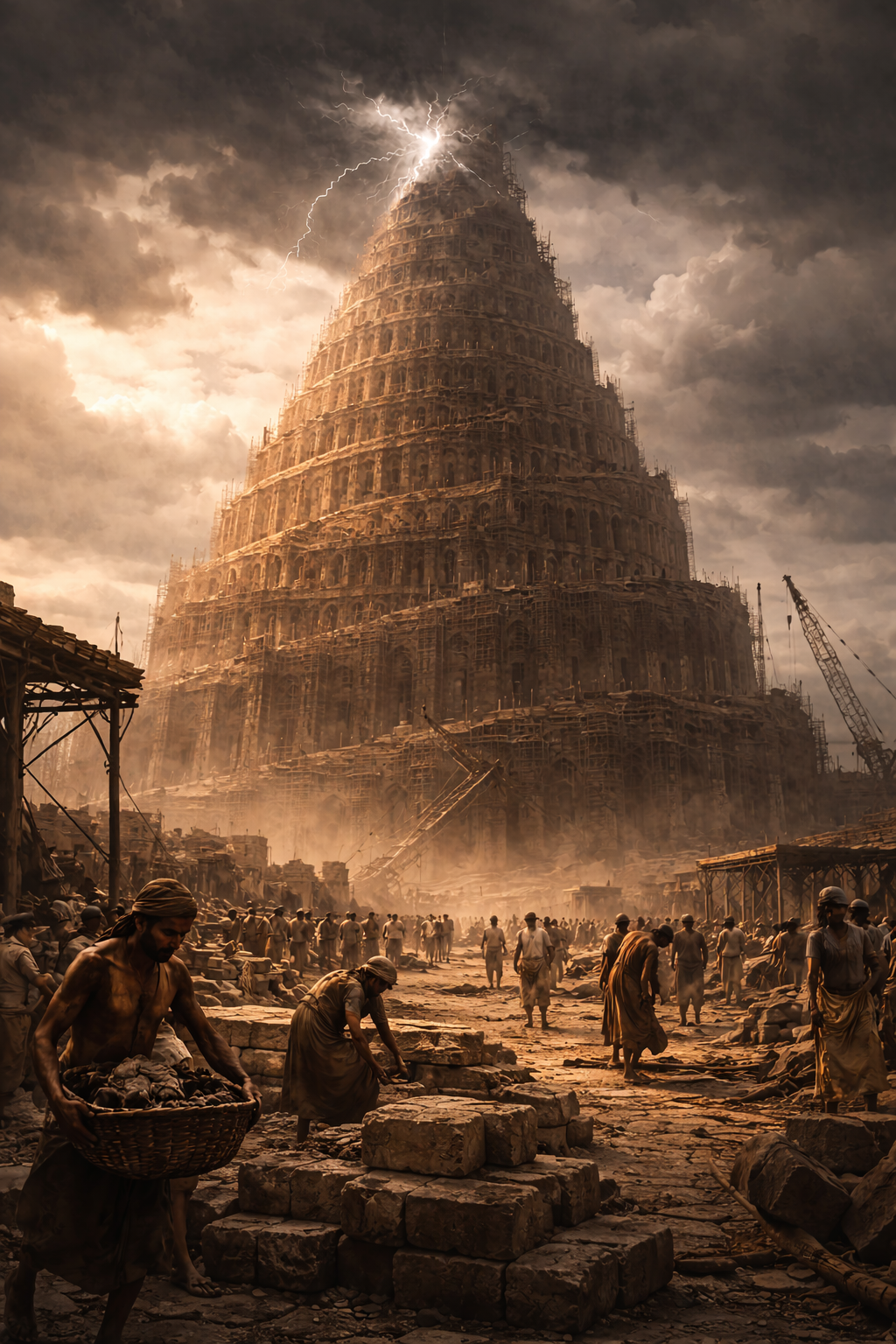
The story of the Tower of Babel in Genesis 11:1–9 explains why people across the world speak different languages. It also reveals something deeper about human pride, ambition, and the limits God places on humanity.
The Story
After the flood wiped out everything, Noah’s family started over.
God had saved them, made a promise never to flood the earth again, and given them clear instructions:
“Be fruitful. Multiply. Fill the earth.”
Spread out. Go everywhere. Don’t cluster in one place.
For a while, that’s what happened. Families grew. People moved. Civilization began rebuilding itself.
But then something shifted.
Instead of spreading across the earth like God said, people started gathering together. They found a plain in a region called Shinar and settled there. All of them. One place. One language. One united ambition.
And that ambition had nothing to do with God.
Someone had an idea.
“Let’s make bricks,” they said. They’d figured out how to bake clay into strong building materials. This was cutting-edge technology for the time—no more piling stones, they could manufacture uniform bricks and build something massive.
So they said to each other: “Come, let’s build ourselves a city, with a tower that reaches to the heavens, so that we may make a name for ourselves and not be scattered over the face of the whole earth.”
Read that again. Their stated goal was the exact opposite of what God told them to do.
God said: spread out.
They said: let’s stay together so we don’t get scattered.
This wasn’t about worship. It wasn’t about reaching God. It was about reputation. Legacy. Control. They wanted to build something so impressive, so towering, that their names would echo through history. They wanted security and significance on their own terms—no dependence on God required.
The tower wasn’t just architecture. It was a monument to human pride. A declaration of independence.
But then the Bible says something almost humorous:
“The Lord came down to see the city and the tower the people were building.”
Came down?
No matter how high they built, God had to come down to even see it. Their grand tower—their greatest achievement—was so small from God’s perspective that he had to descend just to get a good look.
God wasn’t threatened. He wasn’t worried. But he saw what was happening—and what it would lead to if left unchecked.
“If as one people speaking the same language they have begun to do this, then nothing they plan to do will be impossible for them.”
Unified humanity with a shared language and no regard for God? That wouldn’t end well. Their pride and rebellion would accelerate. The same corruption that led to the flood would grow even faster this time.
So God intervened—not with water, but with words.
He confused their language.
Imagine the chaos. You’re working alongside someone, giving instructions, and suddenly you can’t understand a word they’re saying. They’re speaking gibberish. Or—wait—are you the one speaking gibberish? Everyone’s talking but no one’s communicating.
Work ground to a halt.
Arguments broke out. Confusion spread. Groups of people who could still understand each other naturally clustered together and eventually moved away to find their own space.
The city was abandoned. The tower left unfinished.
They called the place Babel—which sounds like the Hebrew word for “confused”—because there God confused the language of the whole world and scattered people across the earth.
The very thing they built the tower to prevent happened anyway. But now it happened on God’s terms, not theirs.
Where the Tower of Babel Fits in the Bible
Babel comes right after the flood—humanity’s second chance. God had just hit the reset button, wiped away the corruption, and started fresh with Noah’s family.
But it didn’t take long for the same patterns to emerge. The problem wasn’t just “those people back then”—the problem was the human heart. Sin survived the flood because Noah and his family brought it with them into the ark.
After the flood, God told humanity to spread out and fill the earth (Genesis 9:1). This wasn’t arbitrary—it was strategic. Scattering prevents the concentration of power and pride. When everyone’s in one place with one language and one agenda, rebellion becomes easier to organize.
But Babel shows humanity doing the opposite. They gathered. They unified. They built. And their building project was all about them—their name, their security, their glory.
This is the pattern we’ve seen since Eden:
- Genesis 3: Humans want to be like God, knowing good and evil
- Genesis 4: Cain builds a city named after his son (Genesis 4:17)—making a name for his family
- Genesis 6: Violence and corruption fill the earth
- Genesis 11: Humanity unites to make a name for themselves
Each time, the root issue is the same: we want autonomy. We want to be our own gods.
Looking Forward:
Babel explains why we have different languages and scattered nations. But it also sets up what comes next.
Right after Babel (Genesis 11:10–26), the Bible zooms in on one family line—eventually landing on a man named Abram. In Genesis 12, God calls Abram (later Abraham) and makes him a promise: “I will make your name great, and you will be a blessing… and all peoples on earth will be blessed through you.”
See the contrast?
- At Babel, humanity tried to make their own name great
- With Abraham, God promises to make his name great—not for selfish ambition, but so he can be a blessing to others
At Babel, humanity tried to reach heaven by building up.
Through Abraham’s descendant Jesus, heaven came down to reach humanity.
The Day of Pentecost:
There’s a beautiful reversal in Acts 2. After Jesus ascends to heaven, the Holy Spirit comes on his followers at Pentecost. Suddenly, they’re speaking in different languages—but this time, everyone understands. People from every nation hear the gospel in their own tongue.
At Babel, God divided languages to slow humanity’s rebellion.
At Pentecost, God used multiple languages to spread the good news of salvation.
Babel scattered people in judgment. Pentecost gathered people in grace—not to build a tower, but to build a church made of people from every tribe, language, and nation, all united under Jesus.
What’s Happening Here?
Ziggurats:
The “tower” at Babel was likely a ziggurat—a massive stepped pyramid common in ancient Mesopotamia. These weren’t just buildings; they were religious structures where people believed heaven and earth met. The tower “reaching to the heavens” wasn’t literal—they weren’t trying to build into space—it was symbolic. They wanted to access divine power and make themselves godlike.
Babylon (which shares the same root as Babel) later became famous for its ziggurats. The most famous was dedicated to the god Marduk. Throughout the Bible, Babylon represents human pride, rebellion against God, and false religion. It’s the city of man opposing the city of God.
“Let us make a name for ourselves”:
In the ancient world, your “name” was your reputation, your legacy, your significance. To “make a name” meant to establish yourself as someone important, someone who matters, someone who’ll be remembered.
But here’s the irony: we don’t even know their names. The builders of Babel are anonymous. Their great project to ensure they’d never be forgotten… was forgotten. Only the city’s name remains—and it means “confusion.”
Meanwhile, God promised to make Abraham’s name great—and thousands of years later, three major world religions (Judaism, Christianity, Islam) trace their roots back to him.
Why was unity a problem?
Isn’t unity good? Usually, yes. But unity around the wrong thing is dangerous. When everyone’s unified in rebellion against God, that’s not strength—it’s accelerated destruction. God scattered them not out of fear, but out of mercy. He was slowing their descent into deeper corruption.
Why This Matters for Your Life
We’re still building towers. We may not stack bricks, but we build careers, platforms, reputations, brands. We construct identities designed to make us feel significant, secure, and in control. And sometimes—if we’re honest—the quiet motivation underneath is exactly what it was at Babel: “Let’s make a name for ourselves.”
God opposes pride. James 4:6 says, “God opposes the proud but gives grace to the humble.” God didn’t destroy the people at Babel, but he did disrupt their project. When our plans are rooted in pride and self-sufficiency, God often intervenes—not to punish us, but to protect us from ourselves.
Disruption can be mercy. When your plans fall apart, when your carefully constructed tower crumbles, when things scatter in ways you didn’t choose—it might not be punishment. It might be God saving you from building something that would ultimately harm you. Sometimes what feels like failure is actually grace.
Unity without God is dangerous. Not all togetherness is good. When people unite around the wrong values—power, pride, self-glory—it leads to destruction. Real, healthy unity comes from being united under God, not in opposition to him.
God isn’t threatened by your ambition. No matter how high you build, God is higher. Your success doesn’t intimidate him. Your plans don’t worry him. He’s not a rival competing for glory. He’s the Creator who knows what you were made for—and it’s not self-worship.
Whose name are you building? Jesus taught his disciples to pray, “Our Father in heaven, hallowed be your name” (Matthew 6:9). The goal of life isn’t to make your name great—it’s to honor his name. When you live for God’s glory instead of your own, you find the significance you were looking for all along. Ironically, you make a lasting name by forgetting about making a name.
Think About It
1. Where in your life are you trying to “make a name for yourself”—build a reputation, secure your legacy, prove your worth? What would it look like to build for God’s glory instead?
2. The people at Babel wanted security and control on their own terms, without depending on God. Where are you tempted to trust your own abilities, plans, or achievements more than God’s guidance?
3. Has God ever disrupted your plans in a way that felt frustrating at the time but later protected you or redirected you toward something better?
4. God scattered the people at Babel, but at Pentecost he gathered people from every language to hear the gospel. How does that reversal change how you see God’s purposes in your life when things fall apart?
Frequently Asked Questions About the Tower of Babel
Why did God stop the Tower of Babel?
The tower itself was not the main issue. The problem was the pride behind it. The people wanted to make a name for themselves and unite in their own strength rather than depend on God.
Why did God confuse the languages?
By confusing their language, God disrupted their ability to continue building the tower. This forced people to spread across the earth instead of staying together in one place.
What does the Tower of Babel represent?
The story represents human pride and the desire to elevate ourselves above God. It shows how quickly unity can become dangerous when it is driven by arrogance instead of humility.
Where was the Tower of Babel built?
The Bible says the people settled in the land of Shinar, which is generally believed to be in the region of ancient Mesopotamia.
How does the Tower of Babel connect to the rest of the Bible?
The story explains why humanity becomes scattered across the earth with different languages. It also prepares the stage for the next major movement in the Bible, when God calls Abraham in Genesis 12.